
Updated November 2026 · By Terry Barkhuizen, NOM-08 certified tour guide (credential N012608). Entry prices are approximate and change often.
Part of our Cenotes of the Riviera Maya guide.
As someone who spends a lot of time exploring the Riviera Maya, one of the questions I’m asked the most is, “What exactly are cenotes?” I’ve had the privilege of guiding countless travelers to some of the most breathtaking cenotes, and it never fails to amaze me how magical these natural wonders are. But cenotes are more than just swimming spots or underground caves – they’re an essential part of the Riviera Maya’s culture, environment, and history.
In this guide you’ll learn what cenotes are, how they formed, why they mattered to the ancient Maya, how to choose the right cenote for you, what it costs, the rules you need to know, and how to visit them safely and responsibly.
What is a cenote?
A cenote (pronounced seh-NO-tay, from the Yucatec Maya word ts’ono’ot) is a natural sinkhole filled with fresh water, formed when limestone bedrock collapses and exposes the groundwater underneath. The Yucatán Peninsula has thousands of them. Because the peninsula has almost no rivers above ground, its rivers flow underground through flooded caves – and cenotes are the windows into that hidden water system.
Near the coast, many cenotes also show a halocline: a shimmering layer where lighter fresh water floats over denser salt water that has seeped in from the sea. Divers and snorkellers see it as a blurry, oily-looking boundary.
How cenotes formed
Millions of years ago the Yucatán Peninsula lay under a shallow sea, building up a thick layer of limestone from corals and shells. When it rose above sea level, rainwater – slightly acidic – slowly dissolved the rock, carving vast networks of underground caves. During ice ages, when sea levels were much lower, many caves were dry and decorated with stalactites and stalagmites; later the sea rose and flooded them. Where cave roofs collapsed, cenotes opened to the sky.
The asteroid impact that created the Chicxulub crater 66 million years ago also shaped the region. In Yucatán state, around Mérida, a striking arc of cenotes – the “Ring of Cenotes” – follows the buried edge of the crater, where fractured rock allowed water to flow more easily.
The importance of cenotes to the Maya
To the ancient Maya, cenotes were far more than a source of fresh water. They were considered sacred entrances to Xibalba, the underworld, and places to communicate with the gods – especially Chaac, the god of rain. Offerings were made in some cenotes, and archaeologists have recovered jade, ceramics, gold and human remains from them, most famously from the Sacred Cenote at Chichen Itza.
The Maya also depended on cenotes for survival. With no surface rivers, cities grew where water could be reached – and many communities in the Yucatán still treat their cenotes with deep respect today. When you visit, you are often a guest on land owned by a local ejido (community) or family.
Types of cenotes
- Open cenotes have lost their roof completely and look like natural pools surrounded by jungle. They are bright, warm and easy for swimmers of all levels. Examples: Cenote Azul and Cenote Cristalino near Playa del Carmen, and Ik Kil near Chichen Itza.
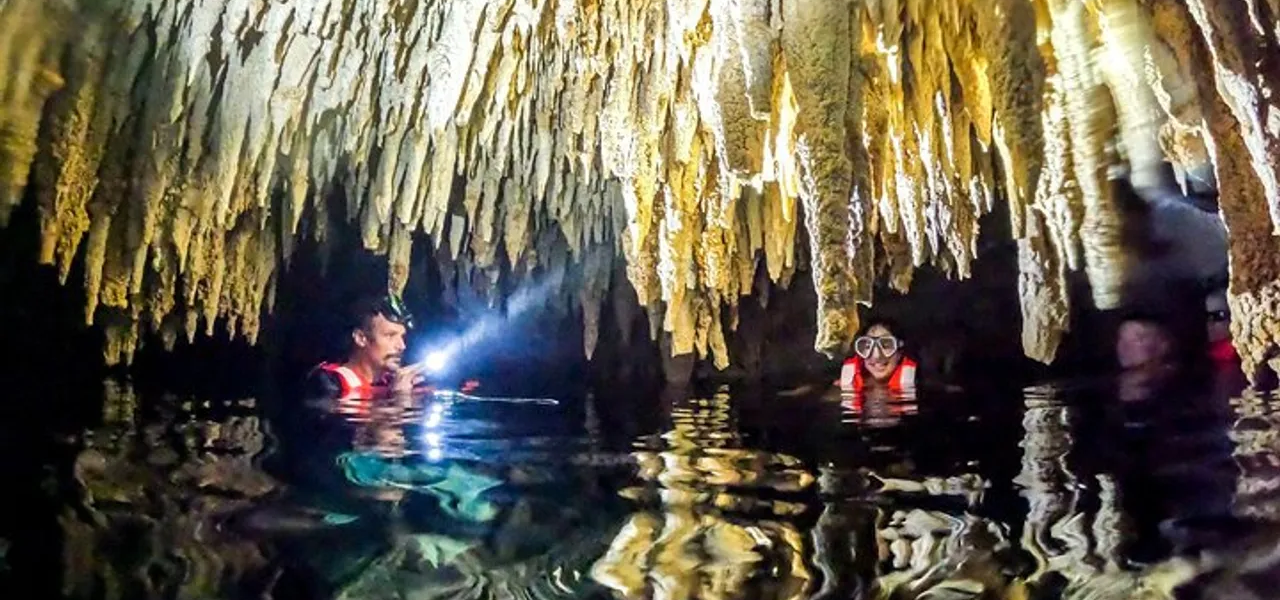
- Semi-open cenotes have a partly collapsed roof, so light pours in through openings into a cave-like space. Examples include Dos Ojos and Cenote Calavera near Tulum.
- Cavern cenotes are caves with daylight still visible from the water – ideal for snorkelling and for cavern diving with a certified guide.
- Cave cenotes are mostly or completely underground and connect to flooded cave passages. The swimming areas open to visitors are lit and roped; the passages beyond are only for trained cave divers. Sac Actun is part of one of the longest underwater cave systems known.
How to choose the right cenote
- Families with small children: open cenotes with shallow areas, stairs or platforms, and life jackets available.
- Nervous swimmers: open cenotes with a rope line along the edge; wear the life jacket.
- Snorkellers: semi-open and cavern cenotes with clear water and light beams – go early for the best visibility.
- Photographers: semi-open cenotes around midday, when light beams are strongest (they are also busiest then).
- Certified divers: cavern dives with a certified cavern/cave guide – never enter overhead environments without one.
- Quiet seekers: smaller, community-run cenotes away from the main tour routes, visited first thing in the morning.
Cenote rules and etiquette
- No sunscreen, repellent or lotions in the water. Most cenotes require you to shower before entering. Wear a rash guard or long-sleeved swim shirt instead of sunscreen.
- Life jackets are mandatory at many cenotes – sometimes for everyone, sometimes for children and weak swimmers.
- Don’t touch the formations. Stalactites and stalagmites took thousands of years to form; oils from skin damage them.
- Stay inside marked swimming areas and never swim into dark passages.
- No food, drinks or rubbish near the water.
- Drones and cameras: drones are usually banned; some cenotes charge a fee for professional cameras or action cams.
- Respect the place. Keep noise down – for many local families, cenotes remain sacred.
What cenotes cost (2026)
| Small or community-run cenote | about 100–250 MXN per person |
| Popular cenotes near Tulum and Playa del Carmen | about 250–550 MXN per person |
| Cenote parks with several cenotes | often higher; check what’s included |
| Life jacket / snorkel rental / locker | often extra, about 50–150 MXN each |
| Guided cavern dive (certified divers) | commonly USD 120–200 for two dives |
Most cenotes are cash only, so bring pesos in small notes.
Activities in cenotes
- Swimming – the water is clear and cool (around 24–25 °C), a perfect escape from the heat.
- Snorkelling – look for small fish, turtles in a few coastal cenotes, roots hanging into the water and light beams.
- Cavern and cave diving – some of the world’s most famous dive sites. Cavern dives (always within sight of daylight) require open-water certification and a certified cavern guide; cave diving beyond the daylight zone requires full cave-diving certification.
- Photography – arrive early for calm water, or around midday for light beams in semi-open cenotes.
Cenote safety
- Wear the life jacket if you are not a confident swimmer; cenotes are deep and the water is cold enough to tire you.
- Steps and platforms are wet and slippery – move slowly.
- Never jump from heights unless the cenote has an official jumping platform and staff say the area is clear and deep.
- Never enter dark passages or cave sections without a certified cave guide.
- Don’t swim alone, and keep children within arm’s reach.
Cenotes near each destination
- Playa del Carmen – dozens of cenotes along Highway 307 between Playa and Tulum, easy by colectivo.
- Tulum – many of the best-known semi-open and cavern cenotes, plus the road to Coba.
- Akumal – Yal-Ku lagoon and cenotes minutes from the turtle bay.
- Coba – underground cenotes near the village.
- Chichen Itza and Valladolid – Ik Kil and the cenotes of eastern Yucatán.
- Bacalar – Cenote Azul and the lagoon’s own sinkholes.
Why we need to protect cenotes
Cenotes are connected to the region’s only freshwater supply. Sunscreen, lotions, sewage and litter don’t just affect one swimming hole – they enter the aquifer that people across the peninsula drink from. Visitor numbers have grown enormously, so small habits matter: shower first, skip the sunscreen, stay on paths, and choose operators and cenotes that limit visitor numbers. Read more in why conscious travel matters at the cenotes.
Frequently asked questions
Can you swim in cenotes if you can’t swim well?
Yes – wear the life jacket (many cenotes provide or require one) and choose an open cenote with stairs and shallow areas.
Are there animals in cenotes?
Small fish are common, and some coastal cenotes have turtles. Bats live in cave roofs. Nothing in the swimming areas is dangerous to people.
What should I bring to a cenote?
Swimwear, a rash guard, water shoes, a towel, cash in pesos and a waterproof phone pouch. Leave sunscreen and repellent in your bag.
What is the best time to visit a cenote?
Opening time (usually 8–9 am) for calm water and few people; around midday for light beams in semi-open cenotes.
Final thoughts
Cenotes are one of the Riviera Maya’s most extraordinary natural wonders, offering not just beauty but a deep connection to the region’s history, culture and environment. As visitors, it’s our responsibility to treat these sacred places with respect and care, so they remain clean and alive for future generations.
Related reading: The cenotes of the Riviera Maya: why conscious travel matters · Responsible wildlife tourism in the Riviera Maya · Tulum travel guide
Where to start
Before your first swim, read our cenote rules and safety checklist.
Ready to choose? Our guide to the best cenotes near Tulum compares Gran Cenote, Dos Ojos, Calavera, Car Wash, Zacil-Ha, Casa Cenote and the Coba cenotes by type, price and who they suit.
Cenotes by area
Near Tulum · Playa del Carmen · Cancun · Valladolid · Chichen Itza.
Getting to the cenotes
Many of the best-known cenotes are just off Highway 307 between Playa del Carmen and Tulum, or on the road from Tulum to Coba. You can reach most of them by colectivo (ask the driver to stop at the cenote entrance), by rental car, or on a guided tour. Arrive at opening time for the clearest water and fewest people. See all our transport guides.